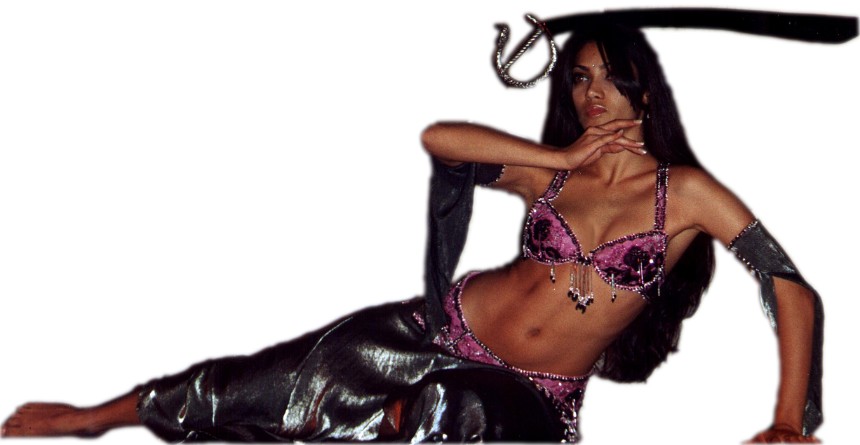
About Carol Miguel
The movement of the body in harmony with music, translated into dance, has always been a passion for her. She has been engaged in dancing since 1993, starting with ballet and jazz dance.
She was captivated by belly dance in 1997 and immediately felt a sense of fulfillment. Since then, with a lot of research and dedication she has been studying and learning about this amazing art.
She started to teach in 1999 and discovered a unique pleasure: sharing with her students the achievements of learning and see them discover and develop themselves in this dance.
In Brazil she had the opportunity to learn with the highly-respected Lebanese belly dancer Brigitte Bacha.
Workshops with many Brazilian belly dancers and masters like Randa Kamel (Egypt) and Saida (Argentina) enriched her training and taught her that diversity and knowledge of various styles are essential for the development of your own style.
About Belly Dance
Belly dance or Bellydance is a "Western"-coined name for a traditional "Middle Eastern" dance, especially raqs sharqi (Arabic: رقص شرقي).[citation needed] It is sometimes also called Middle Eastern dance or Arabic dance in the West, or by the Greco-Turkish term çiftetelli (Greek: τσιφτετέλι). The belly dance style is also quite popular in India, where it has deep cultural roots.
The term "Belly dance" is a translation of the French "danse du ventre" which was applied to the dance in the Victorian era. It is something of a misnomer as every part of the body is involved in the dance; the most featured body part usually is the hips. Belly dance takes many different forms depending on country and region, both in costume and dance style, and new styles have evolved in the West as its popularity has spread globally. Although contemporary forms of the dance have generally been performed by women, some of the dances, particularly the cane dance, have origins in male forms of performance.
- Raqs sharqi (Arabic: رقص شرقي; literally "Dance of the Near East") is the style more familiar to Westerners, performed in restaurants and cabarets around the world. It is a solo improvisational dance, although students often perform choreographed dances in a group.
- The folkloric style, danced socially by men and women of all ages in some Middle Eastern countries, usually at festive occasions such as weddings.
Source: Wikipedia